Why Node.js is Perfect for Building Fast Web Applications
Traditional backend (like those in Java or Python) servers often create a new thread for every user request which is called as a thread-per-request model.
That works… until traffic grows.
More users = more threads = more memory usage = slower performance.
This allows for true parallelism (means working task side by side parallelly) but consumes significant memory and can lead to performance bottlenecks due to thread management and context switching under high load
Node.js took a different approach. Instead of creating many threads, Node.js handles requests using:
A single-threaded event loop
Non-blocking I/O
Asynchronous execution
Rather than creating new threads for each request, Node.js handles all requests on a single main thread . This combination allows Node.js to handle massive concurrency efficiently. Node.js offloads it to the system (via the libuv library) and continues processing other requests. Once the I/O operation completes, its callback is placed in a queue and executed by the event loop when the main thread is free.
Let’s go deep to find about it.
What makes Node.js fast
So, there are several reasons behind Node.js performance
- V8 Engine Executes JavaScript Very Fast
Node.js runs on Google Chrome’s V8 JavaScript engine because that’s what it is made of. V8 converts JavaScript directly into machine code using Just-In-Time (JIT) compilation, which makes execution extremely fast. That means your JavaScript doesn’t stay as interpreted code for long. It becomes optimized machine-level instructions because of whole code is wrapped with C++.
- Non-Blocking I/O
This is the biggest reason Node.js feels fast. Instead of waiting for tasks like:
Database queries
File reading
API calls
Network requests
Node.js starts the task and immediately moves on to handle other work. When the task finishes, Node.js comes back and processes the result. This avoids wasting time waiting. This helps Node.js become faster, or else it would be wasting it’s time on a single heavy request.
- Event Loop Architecture
The concept of Event loop in Node.js is that you can kind of say like it’s a while(true) loop which is continuously keep executing, moving forward and also asking if something’s left.
The event loop continuously checks:
Is any operation completed?
Is any callback ready?
Is any request waiting?
If yes execute it else keep moving. This allows one thread to manage many users efficiently.
- Less Thread Overhead
Traditional servers (like those using Java, PHP, or Python) use a thread-per-request model. When 1,000 users connect, the server tries to create 1,000 threads. Each thread:
Uses memory (for its stack, typically megabytes per thread),
Needs CPU time for scheduling,
Causes context switching—the CPU constantly saves and loads thread states, which slows things down under heavy load.
This adds up fast and limits scalability.
Node.js avoids most of this overhead because it mainly works on a single thread. Node.js handles a request, starts the request (like reading file or Database call) and it doesn’t wait move to the next request, when finished get’s a callback handles the response
Understanding non-blocking I/O
Let’s understand what is I/O.
I/O means:
Reading files
Fetching database data
Calling APIs
Network communication
These operations are usually slow compared to CPU speed.
Blocking I/O (Traditional Style)
This is the way of writing program where it executes synchronously (line by line) and waits of every single line of code.
Imagine this code:
const data = readFileSync("file.txt");
console.log(data);
console.log ("Next task");
The server waits until the file finishes loading. Nothing else can happen during that time. This is called blocking.
Non-Blocking I/O (Node.js Style)
It refers to asynchronous architecture where program doesn’t wait for every line instead it starts the task and move ahead, so no waiting.
Example
readFile("file.txt", (data) => {
  console.log(data);
});
console.log("Next task");
Node.js starts reading the file and immediately continues executing other code. When the file finishes loading, the callback runs.
This is non-blocking I/O.
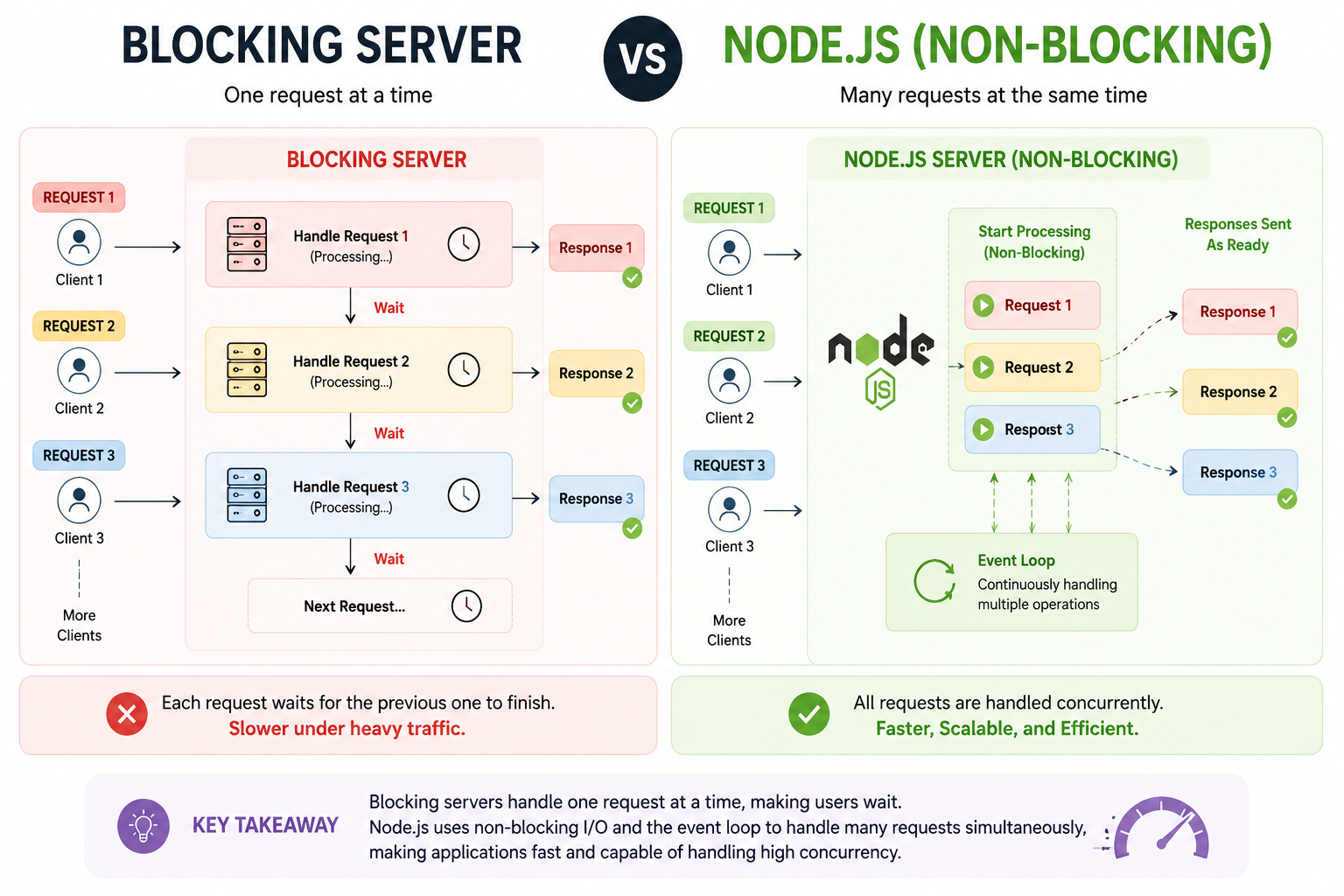
Restaurant Analogy
Blocking Restaurant Imagine:
One waiter
One customer at a time
The waiter:
Takes your order
Goes to kitchen
Waits there
Brings food back Meanwhile, other customers wait. Very slow.
Node.js Restaurant
Now imagine:
Waiter takes your order
Gives it to kitchen
Immediately serves other customers
Returns when food is ready The waiter never wastes time waiting.
That’s exactly how Node.js handles async operations.
Event-Driven Architecture
Event-Driven Architecture in Node.js means the program runs by responding to events like requests, file reads, or timers. Instead of waiting for tasks to finish, Node.js uses callbacks (functions) for events and continues executing code. When an event completes (e.g., a file finishes loading), its callback is triggered. This is organised by the event loop, which constantly checks for completed events and runs their callbacks—on a single thread. This allows Node.js to handle thousands of operations efficiently without blocking the main thread.
For example:
A web server receives a request (event).
It starts reading a file, but doesn’t wait—instead, it listens for the "file read complete" event.
Once the file is ready, the event fires and the response is sent.
Event Loop Visualization
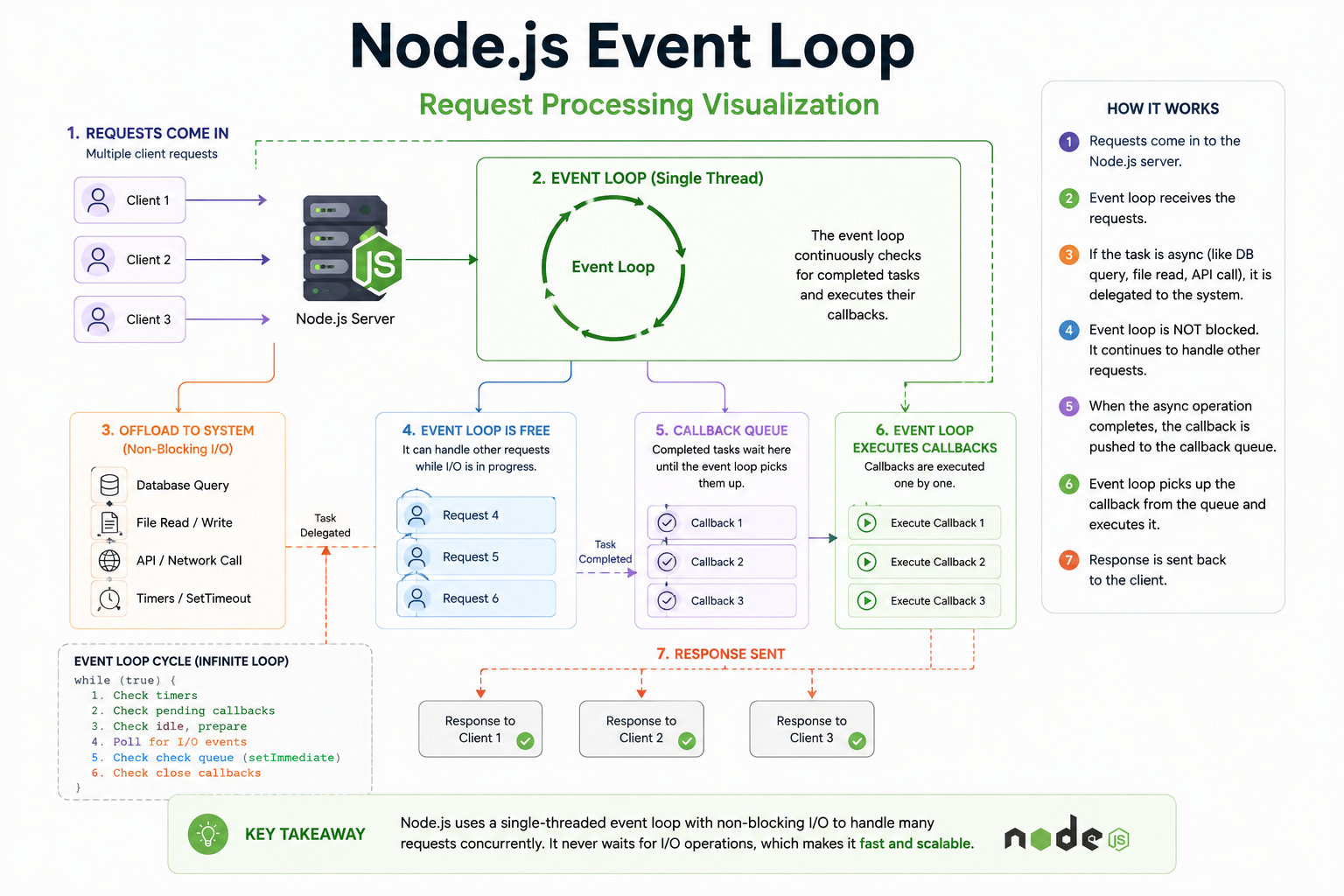
The event loop continuously cycles like
while(true) {
   check completed tasks
   execute callbacks
   process events
}
This is conceptually how the event loop behaves
Single-Threaded Model Explained
One confusing thing about Node.js is “If Node.js uses one thread, how can it handle thousands of users?”
Single Thread doesn’t mean One Task at a Time
Node.js uses:
One main JavaScript thread
Background system threads (default four) (via libuv)
Event loop coordination
The main thread delegates slow operations to the OS or thread pool and continues working.
JavaScript execution is single-threaded. But Node.js itself is not “doing everything alone.” Node.js is not capable of doing all the things itself and for this situation it has libuv behind the scence which manages I/O, network operations, etc.
Concurrency vs Parallelism
Concurrency means managing multiple tasks at once, but not necessarily running them at the exact same time. It uses a single processing unit and switches between tasks quickly, creating the illusion of parallelism. It’s ideal for I/O-bound tasks (like handling web requests), where the CPU often waits.
Parallelism means executing multiple tasks simultaneously, using multiple CPU cores(thread). It’s used to speed up CPU-intensive tasks (like data processing or rendering) by truly running code in parallel.
Simple Analogy:
Concurrency - One chef juggling multiple dishes by switching between them.
Parallelism - Multiple chefs cooking different dishes at the same time.
Node.js uses concurrency via the event loop (single-threaded), while Java/C++ can achieve both concurrency and parallelism using multiple threads.
Where Node.js Performs Best
Node.js performs best in I/O-heavy, real-time, and scalable applications.
Key Use Cases:
Real-Time Applications - Chat apps, live notifications, gaming, and collaboration tools (e.g., Slack, Zoom). Because Node.js handles many simultaneous connections efficiently.
APIs and Microservices - Fast request-response systems are perfect for Node.js. and makes it ideal for REST/GraphQL APIs and backend services.
Streaming Platforms: Netflix and YouTube-like apps use Node.js to streams data efficiently without loading everything into memory.
Where Node.js is NOT Ideal
Avoid Node.js for:
Heavy machine learning processing
Complex CPU-intensive calculations
Video rendering engines
Because these tasks can freeze the event loop.
Real-world companies using Node.js
Many huge companies use Node.js because of its scalability and performance. Popular Companies like Netflix , LinkedIn , PayPal, Uber , Walmart , Trello .
These companies use Node.js for Real-time communication, APIs, Scalable backend services, Fast request handling etc.
Conclusion
Node.js is fast not because it does more work at once, but because it wastes less time waiting. By using non-blocking, I/O and an event-driven architecture, Node.js can efficiently manage thousands of simultaneous requests with minimal resources.
That’s what makes it perfect for modern web applications that require speed, scalability, and real-time performance. Understanding how the event loop works is the key to truly understanding Node.js itself.
Have you built anything with Node.js yet? Let me know what you’re working on. Thank you for reading.


